Tuesday, March 31, 2015
The Lumia 930 enjoys a lot of purrs in its latest ad

Announced earlier this month, the new Moto G succeeds the most successful smartphone in Motorola’s history. The first generation of the stylish, budget-friendly handset is solely responsible for bringing the manufacturer back in contention in a number of key markets globally
The newcomer has grown in size compared to its predecessor, thanks to its larger display. It also packs a microSD card and a duo of stereo speakers. The latter are a truly impressive feature to see on board, as the starting price of the 2014 Moto G has remained unchanged.
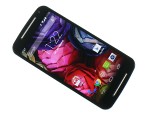
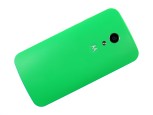
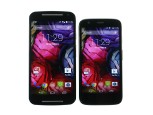
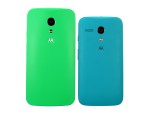
Hardware-wise, the new Moto G packs Qualcomm Snapdragon 400 SoC with 1.2GHz quad-core CPU and a gig of RAM. The display is a 5” IPS unit with a resolution of 1280 x 720 pixels, while an updated 8MP main camera sits in charge of capturing memories.
Moto G (2014) boots Android 4.4.4 KitKat with Google Now launcher. The user experience the smartphone offers is similar to that of a Nexus smartphone.

Samsung Presents Samsung Galaxy S Galaxy Tab

Hardware
What Makes the Galaxy Tab Truly Mobile?
With 3G connectivity, Wi-Fi, and Bluetooth® 3.0, the Galaxy Tab takes mobile communication to a whole new level. By combining Samsung innovation with the Android 2.2 Platform, the Tab is truly a communication and entertainment tool. Its large battery (4,000 mAh) provides more than 7 hours of movie viewing time and because it’s powered by a Cortex A8 1.0GHz application processor, it’s designed to deliver high performance.

Increased Productivity on the Go
Experience PC-like web-browsing and enjoy all forms of multimedia content on the perfectly sized 7” display from anywhere as well as enjoy continuous communication via email, and video call, or social networking with the Galaxy Tab’s optimised user interface. At 7” it’s designed to fit in one hand but it’s easy to type on the Tab using a two hand thumb type style or by using SWYPE input technology.
Front and Rear facing Camera
As online content and creativity explodes, the Samsung Galaxy Tab is the best portable solution for every lifestyle that needs a constant connection. The device’s front facing camera allows for video chat with friends and business partners around the world. And, the rear-facing 3 megapixel camera with flash captures still images and video that can be edited, uploaded and shared.

Watch Video, Read and Play Games on the Go
Its striking 7” TFT-LCD display delivers an exciting mobile experience for watching films, viewing pictures, e-reading or sharing documents. Supporting the latest Adobe Flash Player 10.1, the Samsung Galaxy Tab fully supports swift, seamless viewing of every single page of the web. Flash support provides excellent video and gaming capabilities.
At the same time, HD video content is supported by a wide range of multimedia formats (DivX, XviD, MPEG4, H.263, H.264 and more) which maximises the joy of entertainment.
At the same time, HD video content is supported by a wide range of multimedia formats (DivX, XviD, MPEG4, H.263, H.264 and more) which maximises the joy of entertainment.

Media Hub: Buy Content Once and Share Across GALAXY Devices
At the same time, Samsung has unveiled the Media Hub, a gateway to a world of films and TV shows. Media Hub customers who purchase content to permanently own can share that content with five devices enabled with Media Hub at no extra cost.

Android Marketplace and Google Mobile Services
The Samsung Galaxy Tab is packed with services to complement and enhance life in different ways. There is access the Android™ Marketplace to download apps and personalize devices infinitely, as well as pre-loaded applications that are uniquely designed and optimised for Samsung smartphones and smart media devices.
Services like Google Maps™ Navigation (Beta) and Google Goggles are available on Googles Android platform. With useful location-based services like Google Maps™, search works using Standard English instead of entering an exact address. A search-by-voice function is just as intuitive, meaning searches can also be completed easily on the go. Google Goggles™ is a powerful, visual search tool that uses the Samsung Galaxy Tabs camera to uncover information – an image of a landmark or artwork is automatically used to perform a search, delivering relevant content like a description or history. In addition, with a camera, users can enjoy various augmented reality services which are downloadable in the application market.
Services like Google Maps™ Navigation (Beta) and Google Goggles are available on Googles Android platform. With useful location-based services like Google Maps™, search works using Standard English instead of entering an exact address. A search-by-voice function is just as intuitive, meaning searches can also be completed easily on the go. Google Goggles™ is a powerful, visual search tool that uses the Samsung Galaxy Tabs camera to uncover information – an image of a landmark or artwork is automatically used to perform a search, delivering relevant content like a description or history. In addition, with a camera, users can enjoy various augmented reality services which are downloadable in the application market.
Do More on the Go with the Galaxy Tab™
Why did Samsung make a 7” Tablet—because we’re into mobility and know that people are looking for compact communication and entertainment devices they can slip in their pocket and bring on the go. The Galaxy Tab is always connected, lightweight and smart. Its exceptional screen is designed for reading books and magazines, watching movies and playing games. The Galaxy Tab builds on the rich content experience provided by the Galaxy S line of Android smartphones.
Speed
Galaxy S: Smart Phones with Superior Speed
One of the most important parts of a smart phone is its processor, which is responsible for running all those cool applications lesser phones can’t handle. A good one handles a multitude of functions without sacrificing speed. New phones like the Samsung Galaxy S series offer powerful processors with never-before-seen speeds. Read on to learn why a fast processor matters.Discover a More Efficient Design
A smartphone is a small computer. Some computers have a CPU for running applications, while other functions like display and sound are handled by separate chips. In modern smart phones all those functions are handled by one, dramatically improving speed.
Since smart phones have power-hungry features, like bright screens and intense graphics, saving power wherever possible is important. Today’s smart phone processors can automatically turn off idle features to conserve power.
Since smart phones have power-hungry features, like bright screens and intense graphics, saving power wherever possible is important. Today’s smart phone processors can automatically turn off idle features to conserve power.
Experience Intense Speed
Do you get frustrated when your phone stalls between programmes or while you’re scrolling across the page? Is something as simple as searching through photos or contacts taking longer than it should? The chips in most of the smart phones on the market today eliminate those issues with fast processor speeds.
They run at speeds of 500 or 600 MHz, with some of the latest phones boasting 1 GHz processors. Currently, the fastest available is the Samsung Galaxy S, with a 1 GHz Hummingbird processor. It can process 90 million triangles per second, compared to a Snapdragon processor which processes only 30 million per second. More triangles mean better image quality and much better frame rate—all in all, smoother, more realistic, more detailed graphics. Pair it with 8GB or 16GB of memory and its speed is unstoppable. With practically no waiting involved you can flip through menus, scroll through contacts, and surf the web with extreme ease.
They run at speeds of 500 or 600 MHz, with some of the latest phones boasting 1 GHz processors. Currently, the fastest available is the Samsung Galaxy S, with a 1 GHz Hummingbird processor. It can process 90 million triangles per second, compared to a Snapdragon processor which processes only 30 million per second. More triangles mean better image quality and much better frame rate—all in all, smoother, more realistic, more detailed graphics. Pair it with 8GB or 16GB of memory and its speed is unstoppable. With practically no waiting involved you can flip through menus, scroll through contacts, and surf the web with extreme ease.
Enjoy Blazing-Fast Multimedia
More and more smart phone makers offer a video and web experience similar to that of PCs. Because of that, the number of people that play mobile games on their smart phones has grown substantially.

For serious gaming enthusiasts, speed is everything. With a fast CPU like the one in the Samsung Galaxy S you’ll experience virtually no lag time, fast, and fluid motion along with ultra-realistic 3D graphics and intense colour. Uploading and downloading movies is also faster, and watching them is breathtaking thanks to incredibly smooth playback.
Multitask Like Never Before
A powerful processor on your phone can make a serious difference in everything you do. With a 1GHz processor like the one in the Samsung Galaxy S, speed is never an issue. Its Hummingbird processor is twice as fast as other leading Android processors. Open and transfer files, zoom in and out of pictures, write and send emails and fly through applications effortlessly, in mere seconds.
Power
Google Android OS Explained
Meet the new mobile standard—What’s Android OS? In short, it’s what makes your Smartphone so smart. Introduced by Google in 2007 as the ultimate mobile operating system, Android is an open source platform that turns your phone into a powerful web browser, game console, and personal assistant all in one. An Android Joins the System
Android uses a fun, easy interface to organise and manage applications on some of the world’s most powerful phones. In fact, carrying around an Android phone is like having a pint-sized laptop right in your pocket.
There are a few mobile operating systems out there—Android is the only one made by Google. Its web functionality is not just an add-on, but a primary part of the experience.
Have a favourite URL? Bookmark it for quick access any time. Prefer a wider view of a particular site? Just rotate your phone and automatically switch to landscape mode.
If you’re a fan of using a cursor, the Samsung Ch@t 335 innovative optical trackpad is like having a mini-mouse built into your phone.
There are a few mobile operating systems out there—Android is the only one made by Google. Its web functionality is not just an add-on, but a primary part of the experience.
Have a favourite URL? Bookmark it for quick access any time. Prefer a wider view of a particular site? Just rotate your phone and automatically switch to landscape mode.
If you’re a fan of using a cursor, the Samsung Ch@t 335 innovative optical trackpad is like having a mini-mouse built into your phone.
All About the Apps
The possibilities become limitless with access to the Android™ Market, a huge online bazaar filled with more than 150,000 applications—many of them free—to empower your phone.

Like to cook? Try the Jamie Oliver 20 minute meals app. Are you a sports fan? Live game updates are always just a few taps away with Sky Sports app. Productivity, entertainment, social networking, and causal games are in the palm of your hand, at all times.
Before you even visit the Market, you can check out Android’s pre-loaded selection of applications, ranging from YouTube™ to the Google Maps™ and search functions.
Before you even visit the Market, you can check out Android’s pre-loaded selection of applications, ranging from YouTube™ to the Google Maps™ and search functions.
Always Getting Better
Your Android phone will just keep getting better. Unlike other closed systems that depend on one company for innovation, Android is an open platform, meaning that both Google and its partners are constantly making improvements.
Since its open source release in 2008, Android has had numerous updates—each bursting with new features and enhanced performance.
And because Android is software, there’s no need to buy a new phone to reap the benefits when it upgrades.
Since its open source release in 2008, Android has had numerous updates—each bursting with new features and enhanced performance.
And because Android is software, there’s no need to buy a new phone to reap the benefits when it upgrades.
Ever Ready and Future-Forward
So what is Android? It’s having all the information you need at your fingertips. It’s the comfort of knowing that your phone’s operating system will constantly be up to date. And it’s about being connected today, always ready for tomorrow.
150K+ Apps
What is Android?
Android is the only mobile operating system created by Google. It virtually turns your mobile device into a pocket-sized personal computer. Android comes with a full web browser and Internet surfing capabilities, access to over 150,000 applications through the Android™ Market, including Gmail and Facebook, plus the ability to play games, enjoy music and videos, send text messages, and make calls on your phone.
Android is open-source software, which means anyone can make the operating system better. That way, you benefit not only from the knowledge of Google developers but that of third-party developers too. You can also upgrade your existing Android phone to 2.2 and get the same benefits without spending an extra penny.
Android is open-source software, which means anyone can make the operating system better. That way, you benefit not only from the knowledge of Google developers but that of third-party developers too. You can also upgrade your existing Android phone to 2.2 and get the same benefits without spending an extra penny.
Increased Speed and Performance
With Android™ 2.2, your device is instantly 2-5 times faster, meaning things like restaurant searches, email and apps will run smoother and feel more responsive. Your device’s web browser will also run JavaScript, a language that enables much of the interactivity on today’s Web, 2-3 times quicker than before.
Instant Wi-Fi Hotspot
Android™ 2.2 lets you turn your device into a portable Wi-Fi hotspot and use it to provide Internet access to your laptops and gaming consoles, just like a wireless connection you might find in your home or at a cafe. Once connected, you’ll be able to access the Internet using the same network on which your device normally runs, anywhere you have wireless data coverage.
Better Browser with Flash Support
Unlike some devices, 2.2 takes full advantage of the variety of tools available online. Android™ 2.2 supports Adobe® Flash® 10.1, Adobe® Air®, file uploading and Chromes V8 JavaScript engine so you can access the full Internet along with great games and interactive web pages.
And more...
Here are a few of the other new things you can do in Android™ 2.2:
- Download music directly to your device through the Android™ Market.
- Make hands-free calls on your phone with voice dialling.
- Easily restore app data in case you lose your device or get a new one.
- Get additional support for Microsoft® Enterprise and Microsoft® Exchange, including enhanced security and calendar synchronisation.
- Share your contacts over Bluetooth.
Common Questions:
How do I get Android™ 2.2?
Different Android phones from different carriers offer upgrades in a variety of ways. If you already have an older version of the Android™ operating system on your phone, contact your carrier to see how and when you can update your specific model.
Do I have to change carriers to use an Android device?
Nope—The Android™ operating system can be found on devices from many carriers. Visit your carrier’s website to see which Android devices they offer or check out Samsung’s Galaxy S™ smartphones and Galaxy Tab™.
Is there more than one Android Phone?
Yes—There are a variety of phones offering the Android™ 2.2 operating system making it easy to find one that has the features and service plan you need. Check out Samsung’s Android phones or contact your current provider to see which ones they carry.

Display
Samsung Galaxy S
Samsungs Super AMOLED™ Screen makes mobile more fun to watch with:
- Bright and clear picture
- Accurate colour display
- Reduced glare with an 180º viewing angle
- Thin, light and responsive screen
- Up to 7 hours* of battery life while viewing movies
Its everything a high-definition like experience should be, on your phone.

Samsung Galaxy Tab
The new Galaxy Tab sets the stage for rich, cinematic media with:
- 1024 x 600 resolution for PC-like web-browsing
- Bright colours and clear pictures with enhanced TFT technology
- Brilliant 7-inch display
- Ultra portable, 12-millimeter thin body that actually fits your pocket
- Up to 13 hours* of continuous usage time
Camera and Video Chat
The Galaxy Tab is making video chat and photos easy wherever you are with:
- Front-facing 1.3 megapixel camera and camcorder for video chat
- Programmes for one-on-one video chat over Wi-Fi
- Rear-facing 3-megapixel camera and camcorder for high-quality mobile pictures and videos
Software

Media Hub
Samsungs Media Hub app brings all-star entertainment to the Galaxy S smartphones and the Galaxy Tabs. By joining with top studios, Media Hub gives you access to your favourite movies and TV shows. From a library of over hundreds of titles, rent or purchase new release films. or purchase full TV show seasons on the day of their release and most TV episodes the day after they air. Downloads are saved to your account so theyre never lost and you can even share content with up to 5 Media Hub-enabled devices per account.
Social Networking
As your social hub, download networking tools and fast access to sites like Facebook®, Twitter™ and MySpace™. Use SWYPE® technology to text with friends and family in a whole new way, and a combined inbox compiles all your work and personal emails, calendar events and more.

ZenUI How to Enable Vivid Mode on Splendid

Splendid
ASUS Splendid allows you to easily adjust the display settings. It enriches the color of your screen with these two ASUS Splendid modes: Vivid Mode and Reading Mode.
ASUS Splendid allows you to easily adjust the display settings. It enriches the color of your screen with these two ASUS Splendid modes: Vivid Mode and Reading Mode.
Vivid Mode
Enable the Vivid Mode and customize the image settings such as color temperature, hue, and saturation.
- From your Home screen, do any of the following to launch ASUS Splendid:
•• Tap Asus > Splendid.
•• Tap > Splendid.
 - Adjust the screen color temperature and contrast through the Temperature and Enhancement tabs.
- Tap Done to apply the changes
Firefox OS could your next smartphone cost just £15
Android accounted for 81% of worldwide smartphone shipments in the third quarter of 2013 and iOS mopped up most of the rest according to a study by IDC.

With that in mind it could be easy to think that Mozillas new Firefox OS is doomed to fail; after all, how can it hope to compete with the sales figures of Apple and Google, especially when veterans like BlackBerry and big names like Microsofts Windows Phone are struggling to make much of a dent in global sales?
But Firefox OS isnt just another smartphone operating system. Its fundamentally different in creation to any of the major players and Mozillas tactics and aims are somewhat different too.
The goal of Firefox OS is primarily to create a truly open ecosystem, one where all apps can run on other operating systems and on almost any hardware. In other words: do away with the walled gardens that weve all become so accustomed to on phones.
Other smartphone platforms require apps to be developed specifically for them, so if a developer wants to put an app on multiple device types then it has to be manually ported each time.
It also means that if a user ever abandons one operating system for another they wont be able to access their apps anymore. Theyll have to find and buy them all again and thats if theyre even available.
Firefox OS handles apps more like the internet handles web pages. Rather than proprietary tools theyre built using open web standards like HTML5 and JavaScript, so they can run on just about any computing device that has access to Firefox, meaning Android phones and PCs alike can make use.
In other words theyre platform agnostic and as both Firefox OS and its apps have low hardware requirements you can access them on very affordable devices, designed to make the mobile web more open with minimal barriers to entry so the maximum amount of users can get involved.
Its a lofty goal, but if Firefox OS wasnt so ambitious and so different it would have little hope of attracting any attention at all in the congested smartphone market - although its worth noting that this project is as much about offering something new to the developing markets as it is trying to break the smartphone stranglehold in the more mature areas.
Firefox OS is also about trust and community development. As a truly open source OS its very transparent, allowing tech-savvy users to see how their personal data is handled, while both individuals and organisations are free to build on and modify Firefox OS to improve it and make it available for other platforms.
Firefox OS has another trick up its sleeve too and its called adaptive app search. Its a search screen which is used both to find apps and documents that are already installed on your phone and web apps that you might be interested in, essentially combining a web search with a search of your phone storage.
Simply type a word out and it will bring back all the relevant results from both local and online content. Web apps can then be used immediately or downloaded to your phone and the results will even adapt to your location when relevant, ensuring you always get the best results possible.
This web-facing approach doesnt mean any phone running Firefox OS has no similarities to your Android or iPhone.
It still uses a lock screen, home screen and notifications bar and handsets which run Firefox OS come with a camera complete with style filters, a music player and FM radio.
On top of that theres the obvious suite of software: maps, the Firefox web browser, Firefox Marketplace for apps, an email app and built in integration with Facebook and Twitter to make users coming from other smartphones should feel right at home.
But even with all the positive aspects of Firefox OS its not really ready to take on Android and iOS. Both of those operating systems have been around for years and gone through numerous changes, while Firefox OS is only on version 1.2.
It also has far fewer apps than either of the big two and so far its only available for a handful of phones, most of which are pretty low end.
So its not likely to tempt too many consumers on these shores in its current state, but then its also not easily available in many of the more developed smartphone nations yet and thats a very conscious decision from Mozilla.
Smartphones are enormously popular in the UK, for instance, where 62.2% of the population has one according to a study by Statista. Disposable incomes are higher too, so expensive flagship phones are in great demand and the super-cheap aspirations of Firefox arent being touted beyond finding some hardware available on eBay.
As such its incredibly unlikely that Firefox OS could make much headway in this area, with users entrenched in iOS and Android and looking for high end handsets.
Its a similar story in the US and other wealthy nations, which is why Firefox OS is not available in them for the most part either. But there are some parts of the world where its a very different story.
In Peru, for example, smartphone penetration stands at just 17%, according to a study by Ipsos Peru, leaving the vast majority of its 30,475,144 strong population without a handset and likely to be more open to an iOS and Android alternative.
This is true when you consider the availability of very affordable phones such as the ZTE Open and could soon be available for phones which cost as little as $25, which puts it in direct competition with the feature phone price range.
In case you havent guessed, Peru is one of the places where you can currently buy Firefox OS phones, showing Mozilla is instead trying to capture new and developing markets where the fact that its so new wont be such a problem and the fact that its affordable will be a huge advantage.
With Firefox OS running on just 128MB of RAM its going to be an appealing option for both customers and manufacturers, who can squeeze the OS into increasingly cheap handsets.
In an interview Mozillas Head of Engineering, Jonathan Nightingale, told us that "our CEO talks about how were going to have 2 billion people joining the web for the first time and weve got about two billion on the web now, so the two billion coming in is going to look really different.
"A lot of people are asking whether Firefox OS is designed for the emerging market and whether thats our segment. Certainly, thats an important place for us to be. Were non-profit, were mission driven so we look at it and think, if those people are coming online, theyre not going to be doing it on a $700 smartphone. We have a real opportunity to introduce something there."
By focusing on developing markets Mozilla is also working towards its goal of bringing the web to more people, as it will get internet enabled phones into the hands of those who may never have owned a smartphone or computer before.
Its a strategy mirrored by the likes of Nokia, which has had plans to build phones that connect the next billion users to the internet and explains why its adding a version of Android (with the Nokia X) to its range to service this market segment which has access to 3G but no fixed landlines.
Other brands, such as Sony, Huawei, LG and Alcatel are all getting behind the open OS, committing to launching hardware with a smattering of devices in the market, with more to come. Its not a huge, sweeping effort to enter the market, but shows that there is at least some intrigue there.
So far things seem to be going according to plan for Mozillas new OS, as back in October it was reported by Telefonica that Firefox OS accounted for more than 12% of smartphone sales in Venezuela and almost 9% in Colombia.
Ultimately, once the OS matures (assuming it survives that long), theres every chance that it will spread to the UK and beyond and until it has matured you probably wont want it anyway.
Even if or when it does go global Mozilla doesnt necessarily need it to compete with Android and iOS.
As a non-profit organisation it doesnt need to be number one, all it needs is for enough people to be using Firefox OS that its a known entity and that developers are making a large number of applications for it, applications which can then be run on other devices, keeping the mobile web open and accessible, which are two of the key stated goals in Mozillas Manifesto.
Firefox OSs use of HTML5 should make it easier for developers to get on board too as many will already know HTML5 and wont have to learn a new programming language. In the words of Nightingale: "Theres 200,000 iOS developers, 600,000 Android developers and theres 8 million web developers out there. If youre not betting on HTML5, youre making a mistake."
But Firefox OS isnt even just about phones. Panasonic for example plans to use Firefox OS in some of its smart TVs, while in the future Mozilla wants to see Firefox OS and the principles of openness that come with it make their way to smartwatches, cars and anything else with an internet connection.
As Firefox OS is an open source system that other companies and individuals are allowed to adapt and use for their own purposes theres no reason it couldnt power stereos, fridges, vacuum cleaners and just about anything else in the future. In fact its ideally positioned to capitalise on the ever growing number of smart devices.
Theres no doubt that it has an uphill struggle, but by taking a different, altogether more altruistic approach to things Mozilla and its Firefox OS might just stand a chance, particularly in developing nations.
But with its focus firmly on the low-end of the market for now its unlikely to be making waves in the more developed nations for the next few years - then again, at such a low cost, its not unfeasible even now that you could pop online and buy an unlocked handset running the platform instead of upgrading to that hyper-expensive flagship model.
Read more »
With that in mind it could be easy to think that Mozillas new Firefox OS is doomed to fail; after all, how can it hope to compete with the sales figures of Apple and Google, especially when veterans like BlackBerry and big names like Microsofts Windows Phone are struggling to make much of a dent in global sales?
But Firefox OS isnt just another smartphone operating system. Its fundamentally different in creation to any of the major players and Mozillas tactics and aims are somewhat different too.
Firefox OS - App freedom
The goal of Firefox OS is primarily to create a truly open ecosystem, one where all apps can run on other operating systems and on almost any hardware. In other words: do away with the walled gardens that weve all become so accustomed to on phones.
Other smartphone platforms require apps to be developed specifically for them, so if a developer wants to put an app on multiple device types then it has to be manually ported each time.
It also means that if a user ever abandons one operating system for another they wont be able to access their apps anymore. Theyll have to find and buy them all again and thats if theyre even available.
Firefox OS handles apps more like the internet handles web pages. Rather than proprietary tools theyre built using open web standards like HTML5 and JavaScript, so they can run on just about any computing device that has access to Firefox, meaning Android phones and PCs alike can make use.
In other words theyre platform agnostic and as both Firefox OS and its apps have low hardware requirements you can access them on very affordable devices, designed to make the mobile web more open with minimal barriers to entry so the maximum amount of users can get involved.
Its a lofty goal, but if Firefox OS wasnt so ambitious and so different it would have little hope of attracting any attention at all in the congested smartphone market - although its worth noting that this project is as much about offering something new to the developing markets as it is trying to break the smartphone stranglehold in the more mature areas.
Firefox OS is also about trust and community development. As a truly open source OS its very transparent, allowing tech-savvy users to see how their personal data is handled, while both individuals and organisations are free to build on and modify Firefox OS to improve it and make it available for other platforms.
Firefox OS - Adaptation
Firefox OS has another trick up its sleeve too and its called adaptive app search. Its a search screen which is used both to find apps and documents that are already installed on your phone and web apps that you might be interested in, essentially combining a web search with a search of your phone storage.
Simply type a word out and it will bring back all the relevant results from both local and online content. Web apps can then be used immediately or downloaded to your phone and the results will even adapt to your location when relevant, ensuring you always get the best results possible.
This web-facing approach doesnt mean any phone running Firefox OS has no similarities to your Android or iPhone.
It still uses a lock screen, home screen and notifications bar and handsets which run Firefox OS come with a camera complete with style filters, a music player and FM radio.
On top of that theres the obvious suite of software: maps, the Firefox web browser, Firefox Marketplace for apps, an email app and built in integration with Facebook and Twitter to make users coming from other smartphones should feel right at home.
Firefox OS - Starting small
But even with all the positive aspects of Firefox OS its not really ready to take on Android and iOS. Both of those operating systems have been around for years and gone through numerous changes, while Firefox OS is only on version 1.2.
It also has far fewer apps than either of the big two and so far its only available for a handful of phones, most of which are pretty low end.
So its not likely to tempt too many consumers on these shores in its current state, but then its also not easily available in many of the more developed smartphone nations yet and thats a very conscious decision from Mozilla.
Smartphones are enormously popular in the UK, for instance, where 62.2% of the population has one according to a study by Statista. Disposable incomes are higher too, so expensive flagship phones are in great demand and the super-cheap aspirations of Firefox arent being touted beyond finding some hardware available on eBay.
As such its incredibly unlikely that Firefox OS could make much headway in this area, with users entrenched in iOS and Android and looking for high end handsets.
Its a similar story in the US and other wealthy nations, which is why Firefox OS is not available in them for the most part either. But there are some parts of the world where its a very different story.
In Peru, for example, smartphone penetration stands at just 17%, according to a study by Ipsos Peru, leaving the vast majority of its 30,475,144 strong population without a handset and likely to be more open to an iOS and Android alternative.
This is true when you consider the availability of very affordable phones such as the ZTE Open and could soon be available for phones which cost as little as $25, which puts it in direct competition with the feature phone price range.
In case you havent guessed, Peru is one of the places where you can currently buy Firefox OS phones, showing Mozilla is instead trying to capture new and developing markets where the fact that its so new wont be such a problem and the fact that its affordable will be a huge advantage.
With Firefox OS running on just 128MB of RAM its going to be an appealing option for both customers and manufacturers, who can squeeze the OS into increasingly cheap handsets.
In an interview Mozillas Head of Engineering, Jonathan Nightingale, told us that "our CEO talks about how were going to have 2 billion people joining the web for the first time and weve got about two billion on the web now, so the two billion coming in is going to look really different.
"A lot of people are asking whether Firefox OS is designed for the emerging market and whether thats our segment. Certainly, thats an important place for us to be. Were non-profit, were mission driven so we look at it and think, if those people are coming online, theyre not going to be doing it on a $700 smartphone. We have a real opportunity to introduce something there."
By focusing on developing markets Mozilla is also working towards its goal of bringing the web to more people, as it will get internet enabled phones into the hands of those who may never have owned a smartphone or computer before.
Its a strategy mirrored by the likes of Nokia, which has had plans to build phones that connect the next billion users to the internet and explains why its adding a version of Android (with the Nokia X) to its range to service this market segment which has access to 3G but no fixed landlines.
Other brands, such as Sony, Huawei, LG and Alcatel are all getting behind the open OS, committing to launching hardware with a smattering of devices in the market, with more to come. Its not a huge, sweeping effort to enter the market, but shows that there is at least some intrigue there.
So far things seem to be going according to plan for Mozillas new OS, as back in October it was reported by Telefonica that Firefox OS accounted for more than 12% of smartphone sales in Venezuela and almost 9% in Colombia.
Firefox OS - Onwards and upwards
Ultimately, once the OS matures (assuming it survives that long), theres every chance that it will spread to the UK and beyond and until it has matured you probably wont want it anyway.
Even if or when it does go global Mozilla doesnt necessarily need it to compete with Android and iOS.
As a non-profit organisation it doesnt need to be number one, all it needs is for enough people to be using Firefox OS that its a known entity and that developers are making a large number of applications for it, applications which can then be run on other devices, keeping the mobile web open and accessible, which are two of the key stated goals in Mozillas Manifesto.
Firefox OSs use of HTML5 should make it easier for developers to get on board too as many will already know HTML5 and wont have to learn a new programming language. In the words of Nightingale: "Theres 200,000 iOS developers, 600,000 Android developers and theres 8 million web developers out there. If youre not betting on HTML5, youre making a mistake."
But Firefox OS isnt even just about phones. Panasonic for example plans to use Firefox OS in some of its smart TVs, while in the future Mozilla wants to see Firefox OS and the principles of openness that come with it make their way to smartwatches, cars and anything else with an internet connection.
As Firefox OS is an open source system that other companies and individuals are allowed to adapt and use for their own purposes theres no reason it couldnt power stereos, fridges, vacuum cleaners and just about anything else in the future. In fact its ideally positioned to capitalise on the ever growing number of smart devices.
Theres no doubt that it has an uphill struggle, but by taking a different, altogether more altruistic approach to things Mozilla and its Firefox OS might just stand a chance, particularly in developing nations.
But with its focus firmly on the low-end of the market for now its unlikely to be making waves in the more developed nations for the next few years - then again, at such a low cost, its not unfeasible even now that you could pop online and buy an unlocked handset running the platform instead of upgrading to that hyper-expensive flagship model.
Smartphones tips and tricks Tablets tips and tricks Smartphones reviews
Smartphones rooting Tablets reviews News from mobile world
Smartphones rooting Tablets reviews News from mobile world
Nokia Asha 503 review One step at a time

Introduction
Asha phones. They take you a long way, but yet make you always want more. In this case, more would mean something with Windows Phone inside. Looks like the right thing for Nokia to do - keep customers in the Lumia waiting room, and away from Android temptation. That said, the Ashas have been putting the smart in dumbphones for a while now, so a cheap droid isnt the only option that users shopping for a touch phone with apps, games and fast data can afford.The Nokia Asha 501 did well to demonstrate the platforms new look and feel, ticking some right boxes for a smartphone wannabe: touchscreen, Wi-Fi, fresh and reasonably fluid OS, and an app store. The Asha 502 and Asha 503 followed it up - the first one adding to the camera, while the one we are looking at now is the lineups top spot, the 3G-enabled Asha 503.
The Nokia Asha 503 is obviously the most feature-rich of the new Asha generation, with a Gorilla Glass-covered 3" QVGA capacitive display, a 5MP camera with LED flash, 3G and Wi-Fi connectivity, optional dual-SIM support, plus expandable memory and the latest Asha Software Platform v1.2.
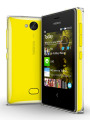
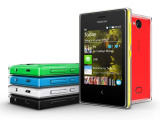
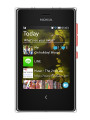
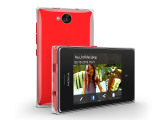
Nokia Asha 503 official pictures
Sticking to a proven recipe, the new Asha 503 is available in six different flavors: yellow, black, green, red, blue and white. Nokia has those eye-catching paintjobs coated in an extra layer of icing, a nice and easy way to jazz up the looks. And its a phone that looks fresh on the inside too - the swipe-driven UI with Fastlane, the ability to run a handful of popular apps and games, a proper app store, social services, good organizing skills and internet connectivity.
Key features
- Quad-band GSM, GPRS, EDGE
- Dual-band 3G with HSPA
- Optional dual-SIM support, dual standby, hot-swappable secondary microSIM
- Nokia Asha software platform 1.2
- 3" QVGA capacitive touchscreen, ~133 ppi, Corning Gorilla Glass 2
- Proximity sensor
- Accelerometer, display auto-rotation
- 64MB RAM, 128MB ROM, 40MB internal storage
- Data-efficient Nokia Xpress browser
- Nokia Store and 40 EA games for free
- 5.0 MP camera, VGA video recording @19fps, LED flash
- microSD card support (up to 32 GB) and 4 GB microSD card in the box
- Wi-Fi b/g/n connectivity
- FM radio with RDS
- Bluetooth v3.0
- Standard microUSB port, charging
- 1200 mAh Li-Ion battery
- Excellent loudspeaker performance
- Solid codec support
Main disadvantages
- Low-resolution screen
- Fixed-focus camera
- No smart dialing
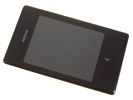
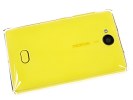
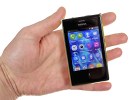
Nokia Asha 503 at ours
You obviously cant have everything and then demand the best of it for this kind of cash. The inevitable compromises aside, the Asha 503 is promising to keep you up-to-date, connected and entertained - and itll give it a decent try. Now, is it enough or is that short step to entry-level smartphones worth it? Lets see. Our hardware checkup follows right after the break.
Nokia Asha 503 retail package
There isnt much room in the Asha 503s retail package except for the basics - a microUSB Nokia charger is supplied, as well as a single piece pink headset.Nokia is also throwing a complimentary 4GB microSD card. No need to search for it in the box though, it is already inserted in the phones memory slot.
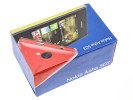
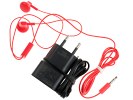
Nokia Asha 503 retail box
Whats missing in the Asha 503s box is a data cable. If you want to use the Mass Storage or do some synching with your computer, youll have to provide your own.
Nokia Asha 503 360-degree spin
The Nokia Asha 503 is very compact and pocket-friendly handset. At 102.6 x 60.6 x 12.7mm, its a mere 3mm taller and 2mm wider than the Asha 501. It weighs in at 110g, 12g more than Asha 501 that is. Both the extra width and weight go down to the icing - the transparent layer the phone is wrapped in.Design and handling
Long story short, the Asha 503 design is just an Asha 501 body in an ice-cube - the transparent coating is pretty much overcooked hyperglaze, but it doesnt look as bad as it sounds. Perhaps the bright yellow of our test unit looks like a splash of paint underneath, liquid, almost milky.We still cant quite decide whether this is a very smart idea or a total waste of material, but we kinda like the look. Not so sure about the feel though. The outer coating tends to get greasy like no other finish weve handled. Fingerprints arent as prominent as on some glossy plastic handsets weve encountered, but theyre definitely there and quite hard to clean too.
The 3" capacitive QVGA display has more than ample bezels, but with a good reason - most of the UI swipes start off the screen. Still, on a phone this size everything is well within comfortable reach and the capacitive display is pleasingly responsive.
The hardware Back button is gone, replaced by a capacitive control. It is still the only means of UI navigation - taps and swipes do all the rest. We feared a capacitive control would stand in the way of swipes starting off the bottom of the screen but that was never the case.
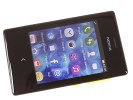
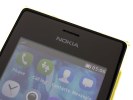
Nokia Asha 503 up front
As usual, the earpiece is above the screen, along with a hidden proximity sensor. There is no light sensor for automatic brightness adjustment, though.
At the back we find the 5.0MP fixed-focus camera lens, the small single-LED flash and a nub at the bottom to push the phone out of the case.
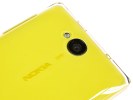
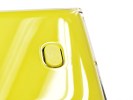
On the back - the 5MP cam and the nub youll use to open the Asha 503
We like how the Nokia Asha 503 looks. It is certainly a bit odd at first with the new transparent layer that can make you think the phone has been put into a case. It is definitely not a feature everyone will be crazy about, especially considering the compromised grip. The Asha 501 is clearly the safer choice in terms of aesthetics but the looks of the 503 can and will be appreciated too.
The Nokia Asha 503 is compact, portable and no hassle to operate single-handedly. Additional battery covers are sold separately so you can freshen up your phone anytime you like.
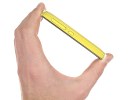
The Nokia Asha 503 in the hand
Display
The display on the Nokia Asha 503 is a 3" TFT unit of QVGA (240 x 320) resolution, which boils down to around 133ppi - the same as the one we saw on the Asha 501. It is of the capacitive variety with multi-touch support, and this time around it even boasts Gorilla Glass 2.Colors arent too great and contrast is limited, but you cant expect much better in this price range. The screen is reasonably bright for an LCD, though its viewing angles are less than stellar. Size may be an issue, as well as resolution, but the response to user input is great.
The display
Our test confirmed the mediocre contrast levels at both full brightness and 50%.
| Display test | 50% brightness | 100% brightness | ||||
| Black, cd/m2 | White, cd/m2 | Black, cd/m2 | White, cd/m2 | |||
| Nokia Asha 503 | 0.28 | 178 | 647 | 0.56 | 358 | 635 |
| Nokia Lumia 520 | - | - | - | 0.51 | 422 | 834 |
| Sony Xperia E | 0.19 | 157 | 813 | 0.50 | 433 | 875 |
| Sony Xperia E dual | 0.21 | 181 | 844 | 0.54 | 473 | 870 |
| Sony Xperia tipo | - | - | - | 0.75 | 561 | 751 |
| Samsung S7500 Galaxy Ace Plus | 0.27 | 239 | 873 | 0.6 | 528 | 888 |
| Apple iPhone 5 | 0.13 | 200 | 1490 | 0.48 | 640 | 1320 |
| Motorola Moto G | 0.35 | 315 | 906 | 0.57 | 550 | 967 |
| Sony Xperia C | 0.18 | 151 | 842 | 0.66 | 639 | 962 |
Sunlight contrast ratio
- Nokia 808 PureView 4.698
- Sony Xperia M 1.473
- Oppo N1 1.470
- Nokia Lumia 610 1.432
- Gigabyte GSmart G1355 1.361
- HTC Desire C 1.300
- Nokia Asha 503 1.281
- Nokia Asha 501 1.270
- LG Optimus L7 1.269
- LG Optimus L9 1.227
- Meizu MX 1.221
- Sony Xperia E dual 1.203
- Samsung Galaxy mini 2 1.114


Nokia Asha 503 display matrix next to Asha 501s
Controls
All hardware controls of the Nokia Asha 503 are on the right side. There you can find the power/lock key and the volume rocker. Both are made of nice matte plastic, offer great tactile feedback and are very easy to locate by touch.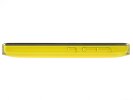
The right side of the Asha 503
There is nothing on the left side of the Nokia Asha 503.
The left side of the Asha 503
At the top theres the microUSB port for charging and data connections. The 3.5 mm headphones jack is also around. Unlike the Asha 501, Nokia has decided not to use the old-gen charging port here.
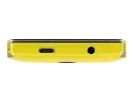
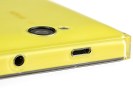
On the top of the Asha 503
The bottom features the microphone pinhole only.
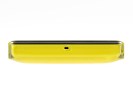
The bottom has the mic
Removing the back cover is easy - a push on the nub at the bottom will make the phones bottom part pop out of the shell. Not as easy as on the Asha 501 though - the slippery surface wont allow a secure hold, so a little extra caution is in order.
You can then go on and take the phone out. Once the battery cover is gone you can access the 1200 mAh Li-Ion battery and the SIM slot beneath. The hot-swappable microSD is on the side.
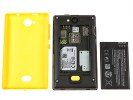
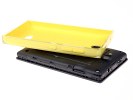
Removing the back cover to access the battery, the SIM card and the microSD slot
The battery life of the Asha 503 is quoted at 840 hours of stand-by and 12 hours of calls over 2G networks or just 4 hours and 30 minutes in a 3G network.
Fastlane is where everything happens
Since it went full touch Nokias Asha Software Platform has always had a lot in common with the abandoned MeeGo - the app drawer/homescreen, the multi-tasking, some icons, even the notification area. The Asha 503 runs on the latest 1.2 version of the software, which brings WhatsApp support and better Fastlane UI with social updates.The Asha platform relies on a single capacitive Back key, and it is only really needed when you need to go a level up from a submenu. For everything else, swipes and taps will do. A double tap will wake the phone up, swiping an app off the screen will close it. We told you - the whole thing is modeled after MeeGo.
Subscribe to:
Comments (Atom)